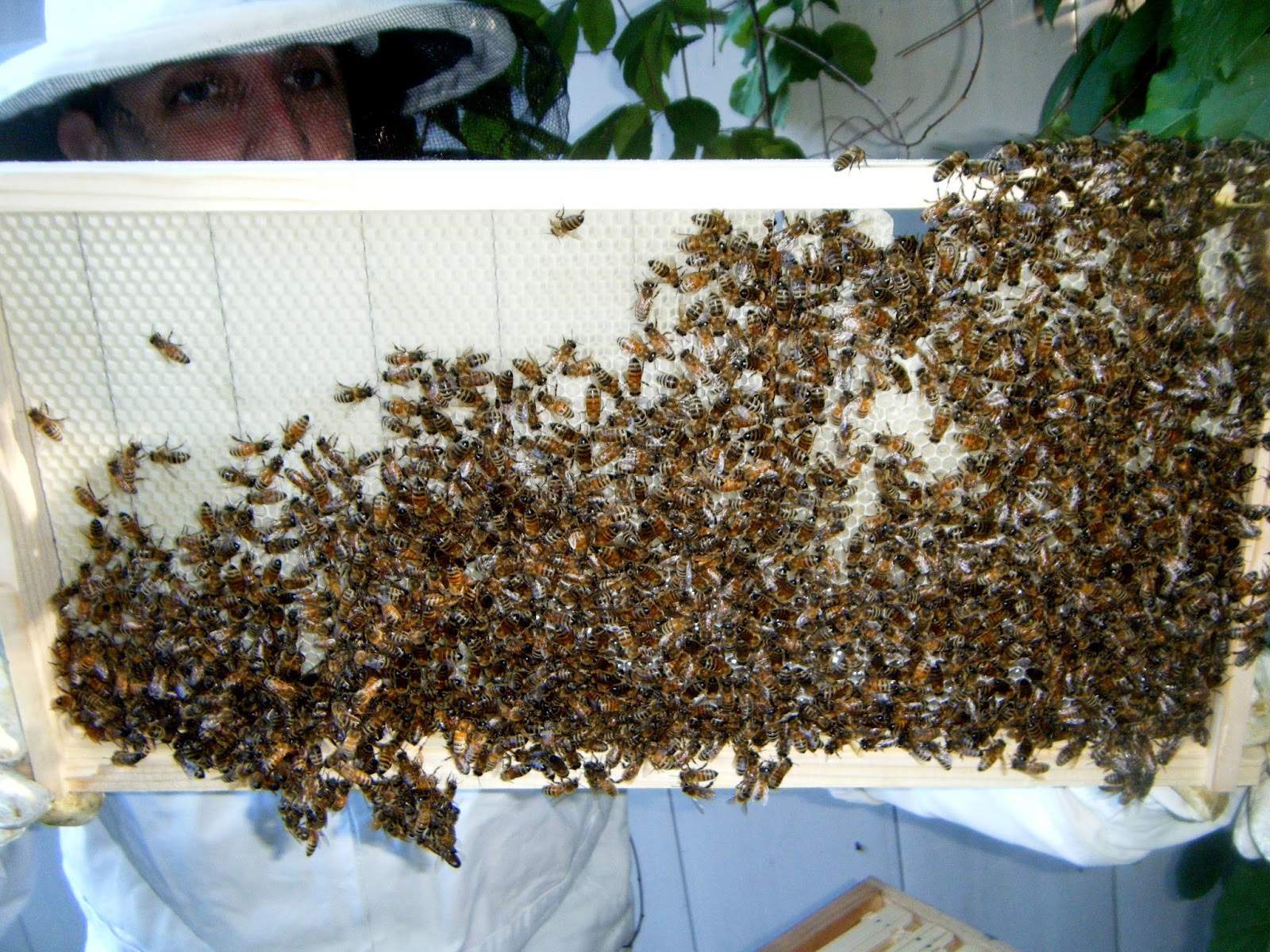
We checked on the swarm yesterday to see how they're faring... and make sure they didn't just move on out for new digs, as swarms sometimes do when caught and hived. Nope, they were still there, and the girls were working their little abdomens off!
Sorry some of the photos are so blurry - that's what happens when I had Eric the camera. But if you look, you can see that on about 4 of the frames, both sides, the girls are building out comb, and if you look closely, you can see that there's a shiny liquid in several of the cells - royal jelly! That means the queen's laying and there're eggs in those cells. Soon... more bees!
Since they're doing so well, you can see in the last photo we switched the entrance reducer to the larger opening. It's a little more space for them to defend, but it gives them more freedom to come and go and do their work.
On another happy note, we checked the three hives in our backyard, and look at this beautiful, beautiful honey!
Monday, June 8, 2015
Friday, June 5, 2015
Eric's an Amazing Ambassador for the Bees
... and a heck of an excellent beekeeper too!
On Wednesday, someone posted in one of our Facebook beekeeping groups about a swarm in Warwick, NY. It was actually kind of funny; the beekeeper was posting from Oklahoma. Turns out this New York family was from Oklahoma, back when the wife's (Gayle) mom was the beekeeper's babysitter. And while Oklahoma's across the country, Warwick's only about 45 minutes from us. Pure luck!
At any rate, he put Eric in touch with Gayle, who'd first posted a photo of the beautiful swarm on her own Timeline. She didn't want an exterminator, because she understands about honeybees, but she also didn't want them hanging over her mailbox indefinitely, or directly over the spot where her kids get dropped off by the school bus, which is exactly where they were.
For those who aren't up on these things, a swarm is what happens when bees get too crowded in their hive. They raise some new queens that stay in the hive, duke it out, and become the new hive royalty, and take the old queen & half the population leaves with her. They form a cluster like this - a swarm - huddling up against an object like a tree branch, a mailbox, a picnic table, even a car fender, and send out scout bees in all different directions. The scouts look for a suitable new home and then come back and waggle dance for the swarming colony; the bee with the best dance wins, and the colony follows her to the new home.
This swarm likely came from one of the nearby orchards; there are a plethora in that part of New York State. I'd know, I've gone apple picking in Warwick!
Bees are amazing creatures. They do so many things they shouldn't be able to physically do. Like fly! With their non-aerodynamic shape and their weight, their wings shouldn't be able to carry them, but they do. They also can hold up some pretty heavy weight, like Gayle's swarm was doing. Ever put a paper clip on a magnet and then touch other magnets to the magnetized paper clip, and keep going to see how long a chain the magnetic force will allow? That's sort of what these bees were doing, but with their own strength. The top bees hang onto the branch, while the lower bees just hang onto other bees, in a cluster, keeping the queen inside to protect and warm her. Crazy, right?
Well, before he left for Warwick, Eric already knew that the swarm was about 15' off the ground, so he brought a ladder, but we only have a shorter one. Gayle and her husband, Mike, have a tall ladder, but it's the kind you need to prop against something, so Eric drove on up, hoping it'd work. In addition to our ladder, he brought his long-sleeved shirt, veil and gloves, bee brush, a saw, and a hive body (a deep, if you check out last week's post), bottom board, cover, entrance reducer, and ratchet strap to tie it all together once he had the bees inside... if he got the bees.
Turned out that the tree was on a slope, too steep for the ladder Gayle and Mike had, and the swarm was of course too high for our ladder. Fortuitously, Gayle and Mike have a pole saw, so Eric borrowed that.
As Eric tells it, the bees chose to fall to a lower branch rather than immediately into the box, so he had to cut that branch down too. Good thing he was dealing with a wonderful family who cared more about helping the bees and getting this experience than losing a couple branches off their pretty evergreen!
Once they were there, he was able to shake the bees off the branch into the hive body. Bees, when they're swarming like this, are actually at their most docile, even though they look really intimidating. They have no hive to protect, so their priority is just to keep the queen safe and wait around for the scouts to tell them where to go.
They were so docile, that the sea of bees buzzing all around Eric weren't the slightest bit concerned with him being there. They weren't even annoyed.
Gayle and Mike's sons were happily watching the whole scene from a nearby tree, unbothered by bees.
Eric knew he had the queen in the hive once the rest of the bees started going into the deep of their own volition. Bees will follow their queen anywhere, so once you've got her, you've got the swarm.
After that, all there is to do is to wait for all the bees to head on in. Eric said it took about 20 minutes.
In the meantime, there were some very interested young men who got to try Eric's veil and gloves so they could see the bees close up too!
And this is how new beekeepers happen! The boys were so excited that Eric is sure they'll be working to convince their parents that they need hives too. Hope they're successful!
Eventually, he had a complete box of bees.
I love that last photo. Once they were all in, he left with a promise from the family that they'll come to New Jersey and visit our hives!
The bees stayed sealed in the hive box all night until Thursday morning, when Eric and I brought them to the house of a friend who wants bees for her garden (and the environment in general), but doesn't want to be a beekeeper. So they're still our bees, just living with her and her husband.
We got the hive placed in its spot behind the peonies. You can see the entrance reducer still on, with a receipt wrapped around the hole in it to keep the bees in safely. It's that pale wood bar right above the front porch there.
Once we got the ratchet strap open, Eric lifted the lid, at which point I found that the girls were all clinging to the top corner of the hive, of course the least convenient place for them to be, at least for our purposes.
I'll admit, it was disconcerting. I've seen photos like this, but it was the first time I was up close and personal with a dense cluster of bees. Eric held the lid over the hive body while I used a bee brush to brush them all in. A bee brush is just what it sounds like, a brush with ultra soft bristles so the bees don't get injured when you direct them where you want them to go.
They didn't get injured, but they definitely got agitated. I was happy to be wearing my jacket, veil, and gloves. By this time, they'd been knocked out of a tree, driven an hour to New Jersey, and then driven again to another house. Plus, now that they had a home, they wanted to get to work building it, not be bothered by us. We were quick, though.
Eventually, we had them where we needed them, added 10 frames of foundation, put on the inner cover, a feeding bucket filled with sugar water (and Honey B Healthy - an essential oil mix that keeps the sugar water from going bad & gives them some added nutrients) in a second deep, and then the outer cover on top. (FYI, frames are literally wooden rectangular frames that we put together, each holding one thin sheet of beeswax foundation for the girls to get a head start working on to build out their honeycomb.)
Our friend had designated a spot for them with welcome signs, since she wouldn't be home when we got there.
We did leave the entrance reducer in (that pale bar right above the front porch/landing board) so that, as a very small colony, they don't have too much space to defend.
The cutest thing... before Eric left the Warwick home on Wednesday, one of the boys gave him a dandelion for the bees (too sweet!), so I was sure to put it on their landing board where they could have it.
I already want to go back to see how they're doing!
On Wednesday, someone posted in one of our Facebook beekeeping groups about a swarm in Warwick, NY. It was actually kind of funny; the beekeeper was posting from Oklahoma. Turns out this New York family was from Oklahoma, back when the wife's (Gayle) mom was the beekeeper's babysitter. And while Oklahoma's across the country, Warwick's only about 45 minutes from us. Pure luck!
At any rate, he put Eric in touch with Gayle, who'd first posted a photo of the beautiful swarm on her own Timeline. She didn't want an exterminator, because she understands about honeybees, but she also didn't want them hanging over her mailbox indefinitely, or directly over the spot where her kids get dropped off by the school bus, which is exactly where they were.
(Photo: Gayle Beck Young)
For those who aren't up on these things, a swarm is what happens when bees get too crowded in their hive. They raise some new queens that stay in the hive, duke it out, and become the new hive royalty, and take the old queen & half the population leaves with her. They form a cluster like this - a swarm - huddling up against an object like a tree branch, a mailbox, a picnic table, even a car fender, and send out scout bees in all different directions. The scouts look for a suitable new home and then come back and waggle dance for the swarming colony; the bee with the best dance wins, and the colony follows her to the new home.
This swarm likely came from one of the nearby orchards; there are a plethora in that part of New York State. I'd know, I've gone apple picking in Warwick!
Bees are amazing creatures. They do so many things they shouldn't be able to physically do. Like fly! With their non-aerodynamic shape and their weight, their wings shouldn't be able to carry them, but they do. They also can hold up some pretty heavy weight, like Gayle's swarm was doing. Ever put a paper clip on a magnet and then touch other magnets to the magnetized paper clip, and keep going to see how long a chain the magnetic force will allow? That's sort of what these bees were doing, but with their own strength. The top bees hang onto the branch, while the lower bees just hang onto other bees, in a cluster, keeping the queen inside to protect and warm her. Crazy, right?
(Photo: Gayle Beck Young)
Well, before he left for Warwick, Eric already knew that the swarm was about 15' off the ground, so he brought a ladder, but we only have a shorter one. Gayle and her husband, Mike, have a tall ladder, but it's the kind you need to prop against something, so Eric drove on up, hoping it'd work. In addition to our ladder, he brought his long-sleeved shirt, veil and gloves, bee brush, a saw, and a hive body (a deep, if you check out last week's post), bottom board, cover, entrance reducer, and ratchet strap to tie it all together once he had the bees inside... if he got the bees.
Turned out that the tree was on a slope, too steep for the ladder Gayle and Mike had, and the swarm was of course too high for our ladder. Fortuitously, Gayle and Mike have a pole saw, so Eric borrowed that.
(Photo: Gayle Beck Young)
As Eric tells it, the bees chose to fall to a lower branch rather than immediately into the box, so he had to cut that branch down too. Good thing he was dealing with a wonderful family who cared more about helping the bees and getting this experience than losing a couple branches off their pretty evergreen!
(Photo: Gayle Beck Young)
Once they were there, he was able to shake the bees off the branch into the hive body. Bees, when they're swarming like this, are actually at their most docile, even though they look really intimidating. They have no hive to protect, so their priority is just to keep the queen safe and wait around for the scouts to tell them where to go.
(Photo: Gayle Beck Young)
They were so docile, that the sea of bees buzzing all around Eric weren't the slightest bit concerned with him being there. They weren't even annoyed.
(Photo: Gayle Beck Young)
Gayle and Mike's sons were happily watching the whole scene from a nearby tree, unbothered by bees.
(Photo: Gayle Beck Young)
Eric knew he had the queen in the hive once the rest of the bees started going into the deep of their own volition. Bees will follow their queen anywhere, so once you've got her, you've got the swarm.
(Photo: Gayle Beck Young)
After that, all there is to do is to wait for all the bees to head on in. Eric said it took about 20 minutes.
(Photo: Gayle Beck Young)
In the meantime, there were some very interested young men who got to try Eric's veil and gloves so they could see the bees close up too!
(Photo: Gayle Beck Young)
And this is how new beekeepers happen! The boys were so excited that Eric is sure they'll be working to convince their parents that they need hives too. Hope they're successful!
Eventually, he had a complete box of bees.
(Photo: Gayle Beck Young)
I love that last photo. Once they were all in, he left with a promise from the family that they'll come to New Jersey and visit our hives!
The bees stayed sealed in the hive box all night until Thursday morning, when Eric and I brought them to the house of a friend who wants bees for her garden (and the environment in general), but doesn't want to be a beekeeper. So they're still our bees, just living with her and her husband.
We got the hive placed in its spot behind the peonies. You can see the entrance reducer still on, with a receipt wrapped around the hole in it to keep the bees in safely. It's that pale wood bar right above the front porch there.
Once we got the ratchet strap open, Eric lifted the lid, at which point I found that the girls were all clinging to the top corner of the hive, of course the least convenient place for them to be, at least for our purposes.
I'll admit, it was disconcerting. I've seen photos like this, but it was the first time I was up close and personal with a dense cluster of bees. Eric held the lid over the hive body while I used a bee brush to brush them all in. A bee brush is just what it sounds like, a brush with ultra soft bristles so the bees don't get injured when you direct them where you want them to go.
They didn't get injured, but they definitely got agitated. I was happy to be wearing my jacket, veil, and gloves. By this time, they'd been knocked out of a tree, driven an hour to New Jersey, and then driven again to another house. Plus, now that they had a home, they wanted to get to work building it, not be bothered by us. We were quick, though.
Eventually, we had them where we needed them, added 10 frames of foundation, put on the inner cover, a feeding bucket filled with sugar water (and Honey B Healthy - an essential oil mix that keeps the sugar water from going bad & gives them some added nutrients) in a second deep, and then the outer cover on top. (FYI, frames are literally wooden rectangular frames that we put together, each holding one thin sheet of beeswax foundation for the girls to get a head start working on to build out their honeycomb.)
Our friend had designated a spot for them with welcome signs, since she wouldn't be home when we got there.
We did leave the entrance reducer in (that pale bar right above the front porch/landing board) so that, as a very small colony, they don't have too much space to defend.
The cutest thing... before Eric left the Warwick home on Wednesday, one of the boys gave him a dandelion for the bees (too sweet!), so I was sure to put it on their landing board where they could have it.
I already want to go back to see how they're doing!
It's about:
beekeeper,
bees,
honey bee,
honey bee swarm,
honeybee,
honeybee swarm,
nj beekeeper,
nj beekeeping,
swarm capture,
Warwick NY bees
Monday, June 1, 2015
Go Girls, Go!
On Saturday morning, the Pooh hive had one honey super. We checked it, and it was nearly full of honey, from end to end!
The Fish hive had one honey super that was partially drawn out with honeycomb, but not yet full of honey.
And the Wonderland hive had two deeps and a feeding bucket.
So by the end of the afternoon, the Pooh hive had two honey supers, the Fish hive had two, and the Wonderland hive had one too!
Five honey supers from two! I can't even imagine if we get all five full of honey in July!
Friday, May 29, 2015
A Glossary of Sorts
It's come to my attention that I'm, well, not really speaking English anymore. I've gotten so immersed in bee culture that I forget not everyone knows the lingo. So here's some, and I'll be adding more as I think to:
A nuc is a nucleus colony of bees, consisting of 4-5 frames (the ones we bought were five-frame nucs) of drawn honeycomb, a couple thousand worker bees, maybe a few drones, and one mated, laying queen. It's like a mini-colony.
You put that into a new hive (the structure), which they then make home and build out into what you hope becomes a strong, full-sized colony.
Colony, by the way, is the group/family of bees living in one hive.
So we've got three colonies in three hives: Winnie the Pooh, Fish, and Wonderland.
People use different size boxes for the brood boxes & honey supers. What we've chosen is to use "deeps" for brood boxes, which is where the bees really live & the queen lays all her eggs. They make & store honey there too, but that honey is left for them to eat. It's also where they store nectar & pollen, and care for the eggs/larvae/pupae and do most of their work inside the hive.
We use "mediums" (a few inches shallower than deeps - 3 mediums ends up the same height as 2 deeps) as honey supers. Once the deeps are filled out, the supers go on top for the bees to fill with just honey, and that's the honey we can take for us to use, eat, and sell. Some people use "shallows" (2" shallower than mediums) for their hives, but we don't bother. It's a matter of what you're comfortable lifting when they're full.
To harvest, we'll be borrowing or buying an extractor. The frames of honey-filled comb are put in after slicing off the beeswax caps from the comb (when the honey is ready, the bees cap it over with wax to keep it stored), and slowly spun so the centrifugal force removes the honey. Then it's put through a sieve or cheesecloth to get out any bits you don't want (we'll be using one that's not TOO tightly woven so it doesn't remove pollen) and jarred.
There you go!
It's about:
bee keeping,
beekeeper,
beekeeper nj,
beekeeping,
beekeeping nj,
bees,
beeswax,
bergen county beekeeper,
honey,
honey bee,
honeybee
Tuesday, May 26, 2015
Just for Kicks
While Eric and I were planting a new peach tree out front, and new plants in our perennial gardens (which reminds me, I really should take photos to post), just for kicks I put my camera on the tripod in front of one of the hives for 20 minutes.
This was around 6 p.m., so not nearly as active as it gets at 3 p.m. in the midst of the afternoon heat and sun, but definitely shows how they behave when they're coming & going.
Thought I'd also throw in a couple shots of our tomatoes, eggplants, and peppers, which are very happy and soon to make our girls very happy too.
Lots more to come as progress is made!
It's about:
bee keeping,
beehive,
beekeeper,
beekeeper nj,
beekeeping,
beekeeping nj,
bees,
bergen county beekeeper,
garden,
gardening,
honey bee,
honeybee
Subscribe to:
Posts (Atom)